Quick verdict: Choose epoxy resin for most craft, coating, jewelry, and tabletop projects because it bonds well, cures with less odor, shrinks less, and is easier to use indoors with proper ventilation. Choose polyester resin when you need a lower-cost option for fiberglass layups, molds, repairs, or projects where strong odor, higher shrinkage, and a more brittle finish are acceptable. Epoxy is usually the better beginner-friendly resin; polyester is more common in marine, automotive, and fiberglass applications.
The best choice depends on what you’re making, what surface you’re applying resin to, your budget, the finish you want, and where you can safely work. Both polyester resin and epoxy resin require gloves, ventilation, eye protection, and careful measuring according to the manufacturer’s directions.
Quick Comparison: Polyester Resin Vs Epoxy Resin
For resin crafts, tabletops, clear coatings, jewelry, coasters, tumblers, and decorative wood projects, epoxy resin is usually the better pick. It tends to be more forgiving for beginners, bonds well to many surfaces, and produces a smoother decorative finish with less shrinkage.
Polyester resin is often chosen for fiberglass work, boat and auto body repair, mold making, and larger utility projects where material cost matters and strong odor can be managed in a shop or outdoor workspace. It can be very useful, but it is not usually the first resin most crafters should reach for when making decorative pieces.
| Criteria | Epoxy Resin | Polyester Resin |
|---|---|---|
| Best uses | Resin art, jewelry, coasters, tabletops, bar tops, river tables, coatings, adhesive bonding | Fiberglass layups, marine repair, auto body repair, molds, rigid utility parts |
| Cost | Usually higher upfront | Often lower upfront |
| Odor/VOCs | Often less odor, but still needs ventilation and PPE | Strong styrene odor; ventilation is especially important |
| Shrinkage | Typically lower shrinkage | Usually more noticeable shrinkage |
| Bonding | Strong adhesion to properly prepared wood, metal, glass, concrete, and cured surfaces | Useful with fiberglass, but often weaker adhesion to some cured or nonporous surfaces |
| Flexibility/toughness | Generally tougher and less brittle | More rigid and brittle, especially without reinforcement |
| Clarity | Many craft formulas are designed for clear decorative finishes | Can be clear, but often less ideal for high-end decorative clarity |
| Cure behavior | Pot life and cure depend on formula, mix ratio, mass, and temperature | Cure can often be adjusted with catalyst within product limits |
| Durability | Durable for coatings and bonding when matched to the project | Durable in reinforced fiberglass applications |
| Beginner friendliness | Usually better for beginners | Less beginner-friendly due to odor, catalyst sensitivity, and shrinkage |
Neither resin is automatically “safe” just because it is sold for crafts or DIY work. Always read the label, follow the exact mix ratio or catalyst instructions, and work with appropriate protection.
What Polyester Resin Is Best For
Polyester resin is a resin system commonly used with fiberglass reinforcement. It is typically catalyzed with MEKP, and the amount of catalyst must stay within the product’s recommended range. Because the cure behavior depends on the resin, catalyst amount, temperature, and project size, polyester resin is not something to estimate casually.
Its biggest strength is practical utility. Polyester resin is commonly used for:
- Fiberglass repair
- Boat repair patches
- Auto body work
- Fiberglass molds
- Rigid molded parts
- Some casting and utility projects
- Larger projects where lower material cost matters
Polyester resin works well with fiberglass mat and cloth, which is why it is so common in marine, automotive, and repair settings. It can cure relatively quickly, depending on the product and catalyst level, and it can be sanded in many repair situations.
The tradeoffs matter for crafters. Polyester resin usually has a strong odor, shrinks more noticeably than epoxy, and can cure to a more brittle finish. It may also have poorer adhesion than epoxy on certain cured, painted, or nonporous surfaces unless the surface is compatible and prepared correctly.
For decorative indoor crafts, those drawbacks can be frustrating. Strong odor, shrinkage, and brittleness are not ideal when you’re trying to make a glossy coaster set, jewelry pieces, or a smooth bar top. Polyester resin has its place, but it is usually best when fiberglass reinforcement, repair work, mold making, or cost-sensitive shop projects are the priority.
What Epoxy Resin Is Best For
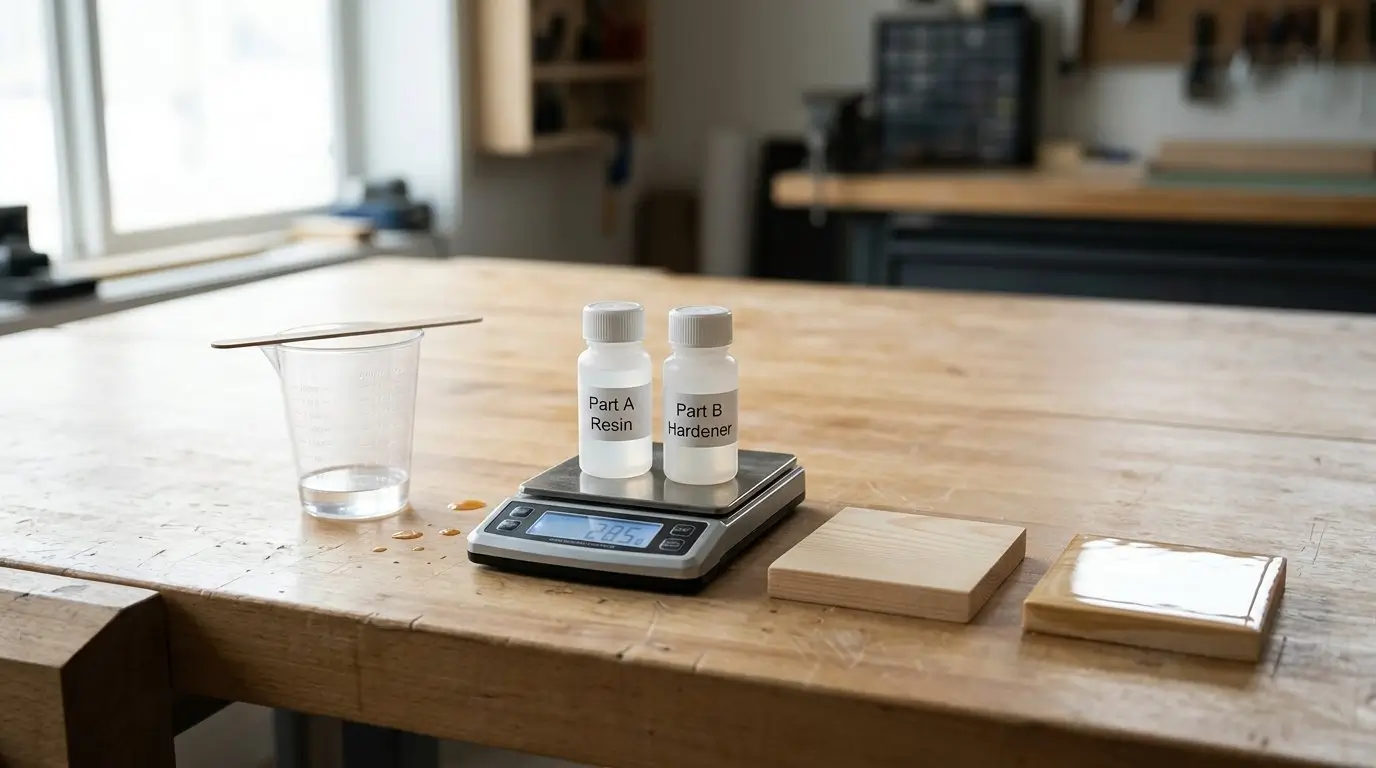
Epoxy resin is a two-part system made of resin and hardener. The two parts are mixed at the manufacturer’s specified ratio, such as by volume or weight depending on the product. That ratio matters. Guessing, adding extra hardener, or switching measuring methods can lead to sticky spots, soft cures, or other finish problems.
Epoxy resin is popular with crafters because it fits many decorative and coating projects, including:
- Resin art
- Jewelry
- Coasters
- Tumblers
- Tabletops and bar tops
- River tables
- Wood coating and sealing
- Clear protective finishes
- Adhesive bonding
Epoxy generally bonds strongly to properly prepared wood, metal, concrete, glass, and many cured surfaces. It also tends to shrink less than polyester resin, which helps when you want a smooth, level, decorative finish. Many craft epoxies are formulated for clarity, making them a good choice for embedded objects, pigments, mica powders, alcohol inks, and glossy topcoats.
Epoxy is not perfect for every project. It usually costs more than polyester resin. Some formulas take longer to cure, and many are sensitive to temperature, mixing accuracy, and pour depth. Epoxy can also yellow over time, especially with UV exposure, although product formulation and storage conditions make a difference.
The key is choosing the right epoxy for the job. A coating epoxy is usually better for thin layers, tabletops, and bar tops. A deep-pour epoxy is designed for thicker pours, such as river tables or deeper molds. Using the wrong type can cause overheating, bubbles, long cure times, or a finish that does not behave the way you expected.
Key Differences That Matter For Your Project
Adhesion
Epoxy resin generally has the advantage for bonding. When the surface is clean, dry, sanded or scuffed as needed, and compatible with the product, epoxy can bond well to wood, metal, glass, concrete, and previously cured surfaces.
Polyester resin bonds well in fiberglass systems, especially when used as intended with fiberglass reinforcement. However, it may not adhere as reliably to some cured resins, painted surfaces, foam, plastics, or nonporous materials. If you are repairing or coating an unknown surface, compatibility testing matters.
Shrinkage and finish quality
Shrinkage is one of the most noticeable differences for craft users. Polyester resin tends to shrink more during cure. On a utility repair, that may be manageable. On a glossy decorative surface, it can affect the final look.
Epoxy resin typically cures with less shrinkage and distortion. That is one reason it is often preferred for tabletops, bar tops, resin art, coasters, and clear coating work. Less movement during cure can mean fewer surprises in the final surface.
Strength, toughness, and brittleness
Epoxy is generally tougher and less brittle than polyester resin. This makes it useful for coatings, bonding, and pieces that need a little more resistance to cracking under normal use.
Polyester resin can be strong in the right application, especially when reinforced with fiberglass. Without reinforcement, it often feels more rigid and brittle. That is not always bad; rigid molded parts and repair patches may benefit from that structure. But for small decorative crafts, brittleness can be a downside.
Odor and workspace
Polyester resin is known for its strong styrene odor. It is much better suited to a well-ventilated shop, garage, or outdoor work area than a small indoor craft room.
Epoxy resin often has less odor, but that does not mean you should treat it casually. Epoxy still requires good ventilation, nitrile gloves, eye protection, and careful handling. Follow the safety directions for the exact resin you’re using.
Cure time and working time
Both resin types vary by formula. Polyester resin cure can often be influenced by catalyst amount, but only within the limits listed by the manufacturer. Too much or too little catalyst can cause problems.
Epoxy resin has a set mix ratio and a pot life based on its formulation, temperature, and the amount mixed. Warm rooms and large batches can shorten working time. Cooler rooms can slow curing. Deep pours require a resin designed for that thickness.
Clarity and UV exposure
For clear decorative work, epoxy usually has the advantage because many craft epoxies are formulated specifically for glossy, transparent finishes. That makes epoxy a natural fit for embedded flowers, glitter, pigments, and coated artwork.
Both polyester and epoxy can yellow over time, especially with UV exposure. A resin marketed as UV-resistant may perform better than one without that feature, but no clear resin should be assumed to stay unchanged forever in harsh sun.
Cost
Polyester resin is often cheaper upfront, especially for larger fiberglass or utility projects. If you’re doing bulk repair work in a ventilated shop, that lower cost can matter.
Epoxy usually costs more, but for decorative projects it may reduce frustration. Better bonding, lower shrinkage, and clearer craft-focused formulas can make the higher price worthwhile when the finish is the main point of the project.
Which Resin Should You Choose?
Choose epoxy resin if…
Choose epoxy resin if your project is decorative, craft-focused, or needs a clean clear finish. It is usually the better choice for:
- Resin art
- Jewelry
- Coasters
- Tumblers
- Bar tops and tabletops
- River tables
- Wood coating and sealing
- Clear topcoats
- Strong adhesive bonding
- Projects where lower shrinkage matters
- Beginner resin crafting
For example, if you’re making a coaster set with mica powder, coating a painted tray, sealing a wood tabletop, or pouring a river table, epoxy is usually the more practical resin to start with. It gives you more options in craft formulas, including coating epoxies, casting epoxies, and deep-pour epoxies.
Choose polyester resin if…
Choose polyester resin if your project is more structural, repair-focused, or fiberglass-based. It may be the better choice for:
- Fiberglass layups
- Boat repair patches
- Auto body repair
- Fiberglass molds
- Rigid molded parts
- Lower-cost bulk work
- Shop or outdoor projects where odor can be managed
For example, polyester resin makes sense for a fiberglass mold, a utility repair, or a boat patch when the product is appropriate for the surface and reinforcement. It is less likely to be your best choice for jewelry, indoor resin art, or a crystal-clear decorative bar top.
Be careful when substituting one for the other
Do not assume polyester resin and epoxy resin are interchangeable. Compatibility can be a problem over cured resin, paint, foam, plastics, and unknown surfaces. Some materials can soften, reject the resin, or fail to bond properly.
If you are unsure, check the product directions and test on a small area or sample piece first. Your decision should come down to four practical questions: Do you need a clear decorative finish? Are you working with fiberglass reinforcement? Can you manage odor and ventilation? Is lower cost more important than ease of use and finish quality?
Tips For Working Safely And Getting Better Results
Good results start before you pour. Read the product label and technical directions for mix ratio, catalyst amount, working time, cure time, recommended temperature range, pour depth, and compatible surfaces.
Use basic protection every time: nitrile gloves, eye protection, appropriate ventilation, and long sleeves if needed. Avoid touching uncured resin, and do not work in a small closed room without airflow. If a product has specific respirator or ventilation instructions, follow them.
For better results with either resin:
- Measure accurately instead of guessing.
- Mix thoroughly for the full recommended time.
- Scrape the sides and bottom of the mixing cup.
- Work in the recommended temperature range.
- Prepare the surface by cleaning, drying, and sanding when needed.
- Make a small test piece when using a new resin, pigment, surface, or mold.
With epoxy, common problems include soft spots from an incorrect ratio or poor mixing, bubbles, dust landing in the finish, and overheating when a pour is too deep for the formula.
With polyester, common problems include strong odor, incorrect catalyst amount, tacky surfaces depending on the formulation, shrinkage, and surface compatibility issues.
The easiest way to avoid failed cures and disappointing finishes is to choose the resin designed for your type of project, then follow that product’s directions closely.
FAQ
Is polyester resin stronger than epoxy resin?
Not usually in a general bonding sense. Epoxy resin typically has stronger adhesion and better toughness on many prepared surfaces. Polyester resin can be strong when reinforced with fiberglass, which is why it is common in marine and auto repair. Strength depends on the resin formula, surface prep, reinforcement, and project design.
Can I use polyester resin for resin art or jewelry?
You can in some cases, but it is usually not the best choice. Polyester resin has a stronger odor, more shrinkage, and a more brittle feel than most craft epoxies. For resin art, jewelry, coasters, and clear decorative pieces, epoxy resin is usually easier to use and better suited to the finish.
Can epoxy resin be used for fiberglass?
Yes, many epoxy resins can be used with fiberglass cloth for repairs, laminating, or reinforcement. Use an epoxy system intended for that kind of work and follow the directions for surface prep, wet-out, working time, and cure. Do not assume every craft epoxy is suitable for structural fiberglass repairs.
Which resin is better for a tabletop or bar top?
Epoxy resin is usually better for a tabletop or bar top. A coating epoxy designed for surfaces can create a clear, glossy, durable finish with lower shrinkage than polyester resin. Choose a formula made for tabletops or bar tops rather than a deep-pour or general-purpose resin.
Does polyester resin smell more than epoxy resin?
Yes. Polyester resin typically has a much stronger styrene odor than epoxy resin. Epoxy may smell less, but both resin types still require ventilation, gloves, eye protection, and careful handling according to the manufacturer’s safety instructions.
Can polyester resin be poured over epoxy resin?
Sometimes compatibility is possible, but do not assume it will work. Polyester resin may not bond well to cured epoxy unless the surface is properly prepared and the products are compatible. Check the manufacturer’s directions, sand or prep as instructed, and test a small sample before committing to the full project.